Mothers Matter
Are We Having Fun YetMothers Matter is Kay Willis’s educational and support organization for parents, founded in Rutherford, New Jersey, on the premise that mothers and fathers become more capable, confident, and joyful when they share the realities of raising children. Its decisive intervention is to make private parenting difficulties speakable: exhaustion, guilt, resentment, isolation, uncertainty, and the need for rest are treated not as personal failures but as experiences that can be examined and answered collectively.
Purpose and Founding
Mothers Matter began with a simple idea: mothers needed to share their secrets in order to increase their skills, confidence, and enjoyment as parents. Kay Willis founded the organization twenty years before the book’s opening account, after recognizing that conventional advice left much of actual parenthood hidden inside what she called a “conspiracy of silence.” Parenting manuals could offer pages of guidance, yet many parents still reached the work unprepared for its emotional and practical demands. Mothers Matter therefore made lived experience itself a form of expertise.
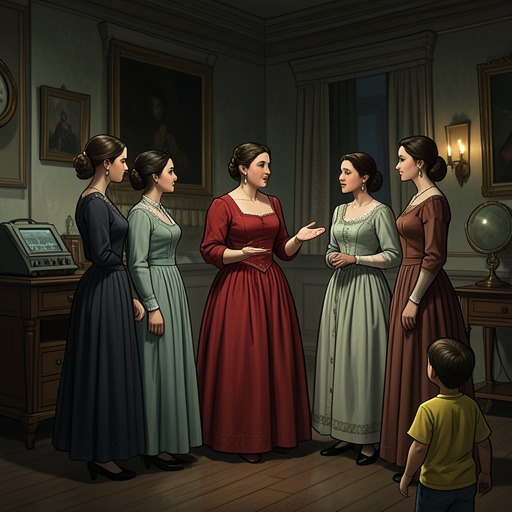
The first group emerged from an exchange between Kay Willis and her young neighbor Diane Jones. Jones had three preschoolers and sought support; Kay Willis, whose youngest child had already started school, reassured her that caring for three preschoolers could be harder than managing ten children in school. Jones invited friends, and seven mothers gathered one afternoon in Kay Willis’s living room. They exchanged ideas and concerns for two hours, complained openly, and supported one another seriously. The conversation was lively enough that they decided to meet again, and additional groups gradually formed.
The organization’s name was coined with help from Kay Willis’s daughter Patty Willis, while her daughter JoEllen Willis proofread the brochure. The brochure’s statement that Kay Willis was the mother of ten children prompted JoEllen Willis to question whether anyone would listen to someone who seemed, in her joking interpretation, foolish enough to have such a large family. Kay Willis rejected that doubt. She regarded both her enjoyment of motherhood and her ten children as credentials, especially because motherhood had no comparable college course or professional preparation despite being one of the most demanding and consequential choices many women would make.
Structure and Participants
The central Mothers Matter groups consist of five two-hour sessions. Mothers bring tears, trials, and triumphs to the meetings, where Kay Willis tells them that they are the real professionals in parenting. The structure gives ordinary parents a setting in which their knowledge is not merely tolerated but actively authorized. The organization’s emotional method combines humor, frankness, mutual testimony, and practical support, allowing participants to recognize their own competence without pretending that parenting is easy.
The organization serves a deliberately varied population. In one northern New Jersey meeting, thirteen women sat in a circle in a church basement: some were full-time earning-money mothers, some were full-time stay-at-home mothers, one was nursing a baby during the discussion, two were single parents, and several worked part-time. Their differences did not erase a common dilemma: the tendency to undervalue their importance as mothers. The group’s function was therefore both supportive and corrective, challenging the assumption that domestic and emotional labor was less important because it happened outside conventional professional institutions.
Mothers Matter also extends beyond its original audience. One of its five sessions is devoted entirely to dads, and Kay Willis offers special programs for new mothers, single parents, full-time earning-money mothers, parents of adolescents, and grandparents. The fifth-session fathers’ meeting takes place in a grammar-school basement library on a Monday evening at 7:30. Hesitant fathers choose seats around a conference table; some attend reluctantly to accompany their wives, while others are curious about Kay Willis. Coffee, tea, and cakes accompany the discussion, which quickly turns to fatherhood and to the question of how important fathers are to their children.
Parenting as Shared Work
Mothers Matter treats support as a practical condition of successful parenting, not as an indulgence added after the real work is complete. Kay Willis’s own experience supplies the model. She credits the help of her mother and her husband with making it possible for her to enjoy being the mother of ten children. Their repeated insistence that she was important, and that no one else could do what she was doing, gave her a counterweight to exhaustion and self-doubt. The organization consequently presents self-care and family care as interdependent: when no one else can provide care, a parent must care for herself.
This principle appears in the organization’s attention to recurring maternal needs. Brand-new mothers may need rest, confidence, self-esteem, and adult conversation, while exhaustion, tears, inadequacy, resentment, isolation, and guilt can fill their days. Mothers Matter does not treat these experiences as evidence that a woman is unsuited to parenthood. Instead, it frames them as signs that support and recovery are necessary. Kay Willis’s message is blunt: guilt wastes time, while recognition of need creates the possibility of action.
The organization’s practical philosophy was shaped by Kay Willis’s mother, who insisted that Kay take time away from her ten children. She made certain that Kay had every Thursday afternoon off, regardless of how difficult the preceding days had been, so that Kay could walk away, refuel, and return restored. When the family moved to a larger house before the birth of its sixth child, Kay’s mother offered to pay for a babysitter every day at 5 P.M. The arrangement came with an explicit purpose: Kay was to do nothing but rest, freshen up, put on lipstick, and pull herself together. These examples turn support from an abstract virtue into scheduled labor, redistributed childcare, and protected time.
Mothers Matter likewise recognizes fathers as participants in, rather than spectators to, family life. Kay Willis argues that mothers are not the only real parents and describes dads as “MVPs—Most Valuable Players.” The organization acknowledges single mothers and women whose husbands work extraordinarily long hours, while still presenting the ideal of two parents happily sharing both the responsibilities and joys of raising children. Its fathers’ program confronts the historical reluctance of men to handle infants: in the 1920s, hands-on fathering could invite ridicule, and even later many men remained uncomfortable caring for their own babies. Mothers Matter attempts to replace that inherited distance with active involvement.
Expansion and Institutional Recognition
The organization expanded through informal publicity before it acquired formal institutional support. Kay Willis contacted the local YWCA, which listed her program in its adult-school mailing. By late 1977, county government had unused funds designated for programs like Mothers Matter. Kay’s first grant application was rejected because she lacked “maintenance of effort,” a requirement she had never encountered. After more than a dozen calls, she learned that she could reapply. On an exact copy of the original proposal, she added the statement that maintenance of effort had been achieved and sustained. Within weeks, she received a one-year, $51,000 grant to open a center for mothers.
The grant required oversight by an existing nonprofit organization, so Kay selected Fairleigh Dickinson University, her hometown neighbor in Rutherford. Institutional approval was not automatic. A county official questioned how Kay could teach without a teaching certificate and told her that she did not qualify because she lacked a degree. The conflict exposed the gap between formal credentials and the experience Mothers Matter treated as authoritative. The organization’s legitimacy rested on the knowledge of a mother who had raised ten children, listened to other parents, and converted repeated domestic problems into a teachable, shareable practice.
The university’s sponsorship later created another form of development. When Kay was encouraged to use free tuition as a role model for the mothers and staff in her program, she enrolled at Fairleigh Dickinson University in the graduate-level course “Women in Transition.” She had left college during her sophomore year and did not ordinarily qualify, but her perseverance and Mothers Matter’s standing secured her admission. She earned three graduate credits without paying the $900 fee. The episode shows the organization moving in both directions: Kay brought maternal experience into an academic setting, while academic sponsorship expanded the institutional possibilities available to her and to the mothers she represented.
Public Reach and Legacy
Mothers Matter became visible beyond its local meetings. Kay Willis appeared on Oprah, Good Morning America, The Today Show, The CBS Morning Show, The Home Show, CNN, and The Joan Rivers Show, while reports on her work appeared in major newspapers and consumer magazines, including the New York Times, Washington Post, USA Today, Christian Science Monitor, Record, and Chicago Tribune. Her public presence allowed the organization’s local language of humor, experience, and mutual aid to circulate through television, newspapers, magazines, and commercial publicity.
That media reach was reinforced by Kay’s work as a spokesperson for Fisher-Price. When a representative sought someone to promote a preschool camera, Kay’s advocacy for Mothers Matter led her to challenge the company’s assumption that a separate camera expert was needed. She sent a dollar and a note betting that she could sell more toy cameras than the expert unless that expert was a mother too. Fisher-Price invited her to a meeting, where her humor and firsthand knowledge of spending money on toys won over the company’s president. She became one of its most successful spokespersons and used a twenty-two-city tour to discuss toys while also sharing her message with parents. Commercial visibility thus became another route through which the organization’s argument about maternal expertise reached a national audience.
Kay also pursued collective visibility for mothers through a convention. In 1984, she organized what the national press called the first convention for mothers, while acknowledging that Mothers of Twins had held annual conventions for years. Conceived in February and realized during the first weekend of May with help from her board of directors, the convention was planned in only two months. The Sheraton Hotel in Hasbrouck Heights, New Jersey, cooperated despite the short preparation period, accepting an $84 deposit when Kay could not provide the requested $400. The convention placed mothers in the same kind of professional and peer setting long associated with business organizations: away from ordinary work, in an atmosphere designed for sharing ideas and discussing what worked and what did not.
By the book’s closing description, Mothers Matter is identified as a national support group for mothers, while Kay Willis is identified as its founder and as the mother of ten children. Its continuing significance lies in the conversion of isolated domestic strain into organized conversation. Through living-room groups, church-basement circles, fathers’ workshops, a mothers’ center, university connections, public appearances, and a convention, Mothers Matter insists that parenting is not something performed with one hand while more important work occupies the other. Parenting is the important work, and the organization’s name states the claim its entire structure is designed to make visible.